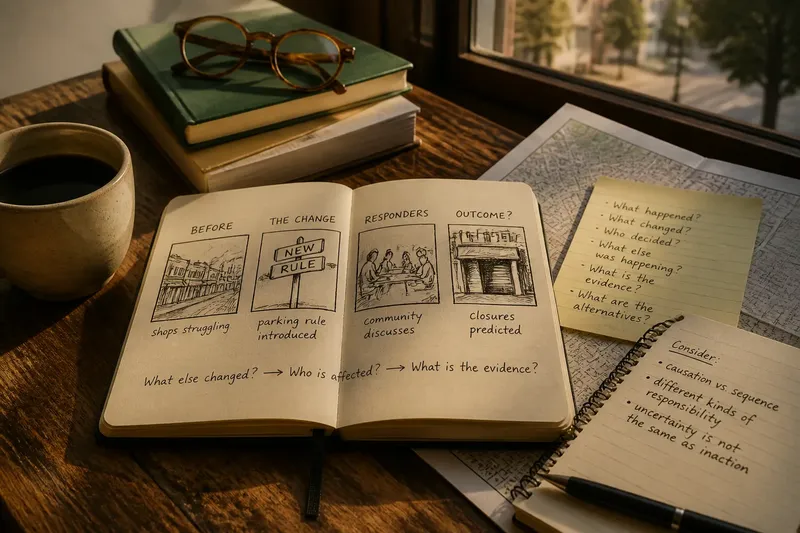
Before a Community Discussion, Write the Question on One Line
A community discussion question written on one line keeps a small group focused, clarifies what counts as a reason, and leaves room to revise its answer.
Before a community discussion, write the question on one line and make sure the group can answer it with reasons rather than slogans. A community discussion question that asks one thing gives participants a shared subject to examine, instead of several neighboring disputes competing for the floor.
This small piece of preparation is not a device for controlling what people conclude. It is a way to make clear what they are trying to decide, what kinds of considerations bear on it, and what remains uncertain until they have heard one another.
What makes a question answerable?
An answerable question names a subject, a decision or judgment, and a context narrow enough for the group to discuss. “What should our library do about evening access during the winter?” gives people something they can assess. “How do we make the town fairer?” may matter deeply, but it contains too many possible decisions to guide one conversation.
Try asking whether a thoughtful participant could offer a provisional answer in a sentence, then give a reason for it. If the question demands a speech about every issue connected to the subject, narrow it. If it can be answered only by guessing what someone else believes, replace it with a question about the matter itself.
Keep the wording open enough to allow disagreement. “How can we improve the library?” quietly assumes improvement is needed and already agreed upon. “Should the library change its evening access, and what considerations should guide that decision?” permits a yes, a no, or a conditional answer.
How narrow should the scope be?
Choose a scope that fits the group’s authority and the time available. Residents discussing a proposed bus stop can consider its location, access, and likely effects on nearby streets. They cannot settle the entire transport policy of a region in the same sitting, however strongly the larger subject may press on the conversation.
Useful boundaries include a particular decision, a defined place, a relevant period, or a group affected by the choice. Use only the boundaries needed to keep the question workable. Too few leave the subject sprawling; too many make the wording sound like a form designed to prevent an answer.
Separate questions that require different kinds of judgment. “Should the council add a crossing near the school, and how should it be funded?” joins a safety decision to a budget decision. The first may be discussed on its own; the second may depend on information the group does not have. Treating them as separate questions helps prevent uncertainty about one from swallowing the other.
What counts as a reason?
A reason connects an answer to something the group can examine. Depending on the question, that may be a stated goal, a practical constraint, a relevant document, a direct observation, or a likely effect on people who will live with the decision. It is not enough to repeat a preferred answer with more confidence.
Before the discussion, jot down a few kinds of consideration that could matter. For a proposed community garden, these might include who can use the space, how access would be arranged, what maintenance the proposal requires, and whether the location fits the group’s stated purpose. This is a menu for attention, not a prewritten verdict.
Do not confuse “what counts as a reason” with “what everyone must agree is decisive.” Participants may accept the same consideration and give it different weight. One person might prioritize an open, welcoming space; another might focus on whether volunteers can sustain the work. The discussion can clarify that difference without pretending it has disappeared.
How can the wording stay fair?
Check the question for assumptions hidden in its verbs and labels. “How should we stop the wasteful proposal?” has already declared the proposal wasteful and assumes it must be stopped. A more open version might ask, “Should the group support the proposal, revise it, or oppose it, and for what reasons?”
Look for terms that sound precise to one participant but not another. Words such as “safe,” “accessible,” “successful,” and “reasonable” may refer to different standards. If a term matters to the decision, ask what participants mean by it or use a more concrete description in the question.
Fair wording does not require pretending that all positions are equally plausible. It requires making the point at issue visible rather than embedding the preferred conclusion in the setup. A question can name a real concern without deciding in advance how that concern should be answered.
What should be settled beforehand?
Settle the question, the basic boundaries, and the kind of answer the group hopes to produce. Is the aim to recommend an option, identify trade-offs, clarify disagreement, or list information still needed? These are different useful outcomes. Naming the aim helps participants judge what a satisfactory exchange would accomplish.
Also decide what material everyone should have in front of them. A short proposal, a map, a plain-language summary, or a clearly identified set of options may help, provided each person can access it. If relevant information is missing, say so plainly; do not turn an unanswered factual question into a contest of certainty.
Leave the conclusion unsettled. The organizer may have a preference, but the group should not be handed a polished answer disguised as a neutral prompt. A discussion is not a ceremonial stop on the way to a decision already made.
How should the group use the line?
Put the question where participants can see it, then return to it when the conversation wanders. This is not a reason to cut off a useful point. It is a way to ask whether that point bears on the question, changes its scope, or raises a separate issue that deserves its own conversation.
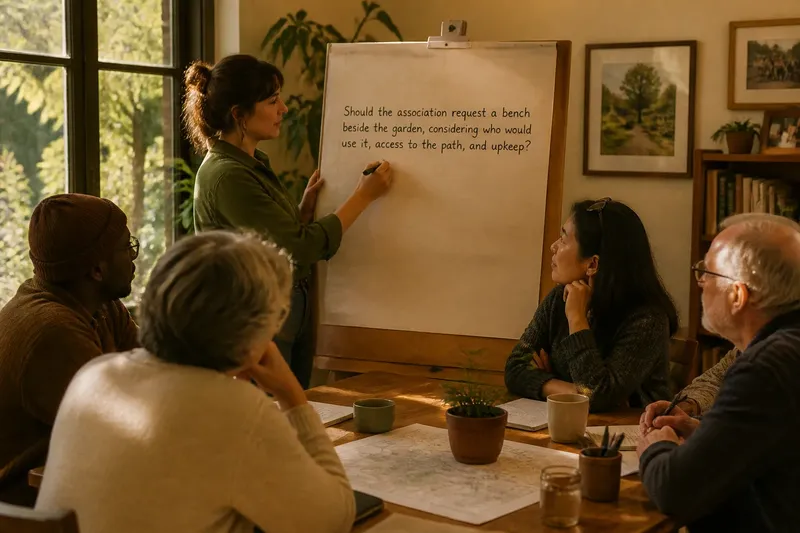
Say you are organizing a discussion about whether a neighborhood association should ask the city to add a bench beside a public garden. You write the question as, “Should the association request a bench beside the garden, considering who would use it, access to the path, and upkeep?” You invite participants to give reasons connected to those considerations, then keep the answer open until people have had a chance to respond. The observable aim is a discussion that can distinguish support, objections, and missing information without mistaking one person’s preference for the group’s conclusion.
Imagine the conversation turns to the garden’s planting plan. That may be relevant if the proposed bench would block a path or affect how the space is used. If the planting plan is otherwise a separate concern, note it for another discussion rather than letting it replace the question on the page. The written line works like a table edge: it gives the conversation a place to set its material, not a rule that every object must stay forever.
When should the question change?
Revise the wording when the group discovers that it is answering a different question from the one written down, or when an assumption proves unclear. A change is appropriate if participants learn that the decision belongs to another body, that the proposed options are incomplete, or that a key word means different things to different people.
Make the revision visible and explain why it is needed. Quietly changing the prompt can make participants feel that the target moved after they took aim. A brief pause to agree on the new wording is usually more useful than pressing on under a question no one recognizes.
Not every new topic requires revision. Sometimes the right response is to record a related question for later. Keep the distinction clear: changing the central question changes the work of the discussion; noting a separate question preserves it for another occasion.
What if participants disagree?
Disagreement is not evidence that the question failed. If participants give different answers but can explain how their reasons relate to the question, the discussion has reached its subject. The next task is to understand what their reasons depend on and whether any relevant information remains unavailable.
When people use the same word differently, ask each to state what it means in their answer. When they agree about the facts but rank the considerations differently, make that distinction explicit. When they dispute a factual claim, record the specific point that needs checking rather than letting the dispute dissolve into a general verdict about credibility.
If the group cannot reach a shared answer, it can still reach a more accurate account of the disagreement. Participants may identify a condition that would change their view, a trade-off they cannot resolve, or a decision that requires further information. That is a substantive result, not a failed attempt to manufacture consensus.
What should happen after discussion?
Close by recording what the group can honestly say: its provisional answer, the main reasons offered, the unresolved objection, and any information needed before a decision. If the group is making a recommendation, distinguish that recommendation from a formal decision by a council, board, or other responsible body.
Return to the original line and ask whether it still describes the issue the group discussed. If it does, keep it with the notes so readers can see what the conclusions address. If it changed, preserve both versions and the reason for the revision. A clear record lets people assess the outcome without having to infer which question the group thought it was answering.
A community discussion question should be concise enough to keep in view and open enough to earn an answer. Write the line before the meeting, name what could count as a reason, and let the exchange—not the organizer’s private preference—shape the conclusion.