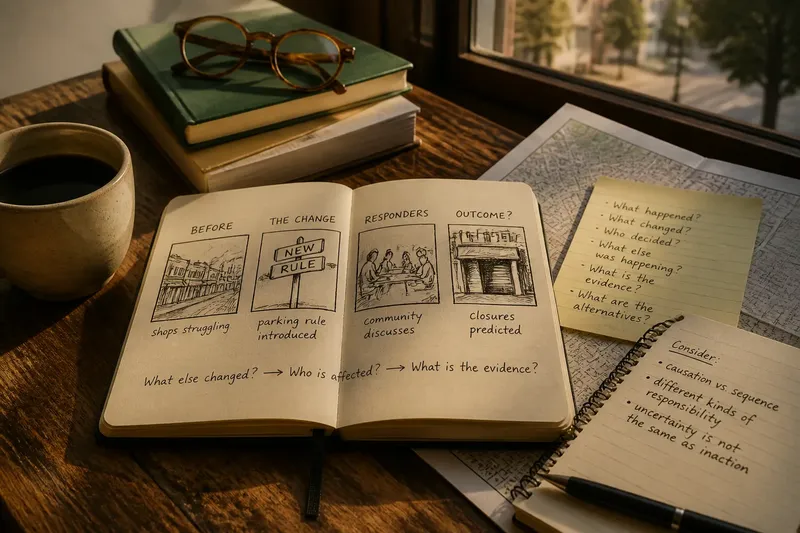
A Claim, Its Reasons and Its Hidden Premises
Learn to separate a public claim, its supporting reasons and hidden premises so you can see exactly where an argument holds or needs more support.

A public claim can sound settled while resting on a reason that does not quite reach it. To examine a claim, its reasons and its hidden premises, separate what a speaker wants accepted from the evidence offered and the unstated bridge between them. That distinction makes disagreement more precise: people can argue about the evidence, the bridge, or the conclusion instead of treating the whole argument as one indivisible object.
1. Find the main claim
Start by asking what the speaker wants the audience to believe, decide, or do. That is the central claim. It may be a description, a prediction, a judgment, or a recommendation, and identifying which kind it is matters because each requires different support.
Consider a city council discussion about a proposed evening bus route. “The council should extend service on this corridor” is a recommendation. “The route currently leaves late-shift workers without a practical trip home” is a descriptive claim. The first may depend on the second, but they are not the same proposition.
Write the claim as one plain sentence, removing applause lines, scene-setting, and requests for solidarity. If a speaker gives several conclusions, keep them separate. A claim that a policy is unfair does not automatically establish that it is ineffective, unlawful, or worth replacing; each added conclusion needs its own reasoning.
2. Sort reasons from claims
Reasons are the statements offered in support of the central claim. Look for phrases such as “because,” “since,” and “the reason is,” but do not rely on those signposts alone. Arguments often place a conclusion first and leave its supporting statements to be inferred from the surrounding discussion.
Suppose a council member says, “Extend the route; shift workers finish after current service ends, and the nearest alternative requires a long walk.” The recommendation is the main claim. The statements about work schedules and the alternative trip are candidate reasons: they describe a problem the proposed service might address.
Now classify each statement by its job. A reason can support the main claim directly, or support another reason that then supports the main claim. “Several employers schedule late shifts” might support the claim that the service gap affects a group of residents; that group-level claim may in turn support a recommendation. This chain matters because a weak link can leave the conclusion unsupported even when another link is sound.
Do not mistake repetition for additional support. Saying that a route is “needed,” “essential,” and “long overdue” may intensify the speaker’s position, but those descriptions do not supply distinct reasons. A reason adds a proposition that could be examined independently.
3. Surface the hidden premise
A premise is a statement an argument needs in order to connect its reasons to its conclusion. Some premises are stated outright; others remain unstated because the speaker assumes the audience shares them. The hidden premise is not automatically a flaw. It is a part of the reasoning that should be made visible before anyone decides whether it is acceptable.
In the bus-route argument, the stated reasons describe a service gap. To reach the recommendation, the speaker also needs a connecting idea, such as: “When a public service leaves a recurring travel need unmet, the council should consider providing a practical alternative.” The audience may accept that principle, reject it, or ask what counts as a recurring need and a practical alternative.
Try supplying the narrowest premise that makes the inference intelligible. A premise that says “the council should do whatever makes life easier” is too broad to clarify the argument and may carry more than the speaker intended. A narrower bridge keeps the reconstruction fair: it explains the inference without adding a new political program on the speaker’s behalf.
One useful check is to ask whether the reasons could be true while the conclusion remained unjustified. If the late shifts and difficult alternative are real, but the route would serve almost no affected riders or conflict with a more pressing service obligation, the recommendation may still need further support. Those possible objections point to additional premises about scale, priorities, and available options.
4. Separate evidence from inference
A stated reason can itself be a claim that needs support. “Late-shift workers cannot get home” is not evidence merely because it appears in the argument; it is a proposition whose basis may include schedules, route information, rider testimony, or other relevant material. Evidence bears on whether a reason is credible. Inference concerns whether that reason supports the conclusion.
Keep those questions apart. Someone might accept that current service ends before some shifts finish yet question whether extending this particular route is the best response. Someone else might agree that the proposal would address the problem but doubt the claim about how many people face it. The first challenges the inference or its connecting premises; the second challenges a supporting claim or its evidence.
Imagine a fictional council hearing where a resident says the final bus leaves before the end of her workplace’s evening shift. The schedule confirms the departure time, while a separate premise says a public route should address recurring trips that residents cannot reasonably make another way. A listener could accept the schedule, ask whether the resident’s trip represents a broader need, and still withhold judgment on the recommendation until alternatives are compared. Each question has a different target.
This separation prevents a familiar conversational slip: replying to a reason’s credibility when the actual disagreement concerns the principle behind it, or debating a principle while ignoring whether the stated facts are true. State the target directly: “I accept that the service ends early, but I’m not yet persuaded that this is the council’s best response.” That answer leaves the accepted point intact instead of pretending it has settled the whole case.
5. Test the bridge
Once the premise is explicit, ask whether it is reasonable, relevant, and broad enough to carry the conclusion. A premise may be plausible but too weak: “Some riders would benefit” does not by itself establish that a public agency should make the change. It may also be relevant but disputed, as when people disagree about what obligations a council owes residents.
Ask what would follow if the premise were applied consistently. If the principle is that public services should address recurring unmet needs, does it apply to other routes or only this one? The question is not a demand to solve every policy issue before considering the claim. It tests whether the stated principle is being used as a genuine reason rather than a convenient bridge built for a single conclusion.
Then check for missing alternatives or conditions. The argument may depend on the route being feasible, reaching the affected area, and serving a need that another available service does not meet. These considerations do not refute the recommendation by themselves. They identify what else must be established before the conclusion follows with adequate force.
A premise can also conceal a value judgment. “The council should prioritize the greatest number of riders” is not a neutral description of route demand; it is a principle about how public resources ought to be allocated. Naming that value gives people a clearer subject for debate. They can discuss the principle openly rather than arguing past one another through competing descriptions of the same proposal.
6. Rebuild the argument
After separating the parts, lay them out in a compact sequence: the main claim, the reasons, the evidence bearing on those reasons, and the connecting premise. This is not a verdict machine. It is closer to labeling objects on a desk: once the pieces are distinct, it becomes easier to see which one is missing and which one is merely being mistaken for another.
For the bus discussion, the reconstruction might read: the council should consider extending evening service; some workers finish after the current final departure, and their alternative trip is impractical; the schedule and available-route information support those statements; and recurring travel needs that lack a reasonable alternative deserve consideration in service decisions. The recommendation is now visible alongside the assumptions it depends on.
Keep the reconstruction proportionate. Do not strengthen the claim into “the council must extend the route immediately” if the speaker only called for consideration. Do not weaken the stated reason into “some people might prefer a later bus” if the argument concerns access to a workable trip home. Fair reconstruction preserves both the force and the limits of what was actually argued.
When the argument has several branches, map each one separately. One reason may support the recommendation through fairness, another through access, and another through operational fit. If one branch fails, the others may remain; if all rely on the same unsupported premise, the apparent variety may be less substantial than it sounds.
7. Choose the right challenge
Once the structure is clear, challenge the part that actually carries the disagreement. Ask for support when a factual reason is uncertain. Offer a counterexample or competing principle when the hidden premise is disputed. Point out a gap when the reasons, even if accepted, do not establish the conclusion. A precise challenge can be firm without turning every conversation into a contest over the speaker’s character.
For example, “What makes this a recurring need rather than an isolated inconvenience?” asks about the scope of a supporting claim. “Why should the council use that principle when another service need is more urgent?” challenges the priority premise. “Even if both statements are true, what shows that extending this route is the right response?” questions the inference. These are different questions, not alternate ways to say no.
It is also possible to accept the central claim provisionally while disputing one reason, or to accept the reasons while asking for a narrower conclusion. A listener might agree that late trips are difficult and that the council should consider the problem, but not agree that this specific route should be extended. Public argument becomes more useful when partial agreement is stated plainly rather than hidden inside a vague “I see your point.”
Questions about premises?
Is an unstated premise always a flaw?
No. Everyday arguments often omit shared assumptions to stay concise. The premise becomes worth examining when people disagree about the conclusion, or when the inference seems to depend on a value or rule that has not been acknowledged.
How can I tell a reason from evidence?
A reason is a proposition offered in support of a conclusion; evidence is material that helps establish whether that proposition is credible. In a public discussion, a route schedule may support the claim about departure times, while that claim serves as a reason for considering a service change.
Can an argument have more than one hidden premise?
Yes. A recommendation may depend on assumptions about public responsibility, the seriousness of the need, the availability of alternatives, and the suitability of the proposed response. Make each premise explicit only when it is needed to explain a particular inference.
What if people disagree about the main claim?
First check that they are discussing the same proposition and its scope. One person may support examining a proposal while another hears a demand to adopt it; that difference is about the claim itself, not yet about its evidence or premises.
Keep the parts distinct
The point of separating a claim from its reasons and hidden premises is not to make civic discussion sound like a courtroom transcript. It is to keep a true supporting fact from being treated as proof of every conclusion, and to keep a disputed value from masquerading as a neutral observation.
For a quick review of a public claim, write down the conclusion, list the reasons, identify what supports those reasons, and state the premise that connects them. Then ask which part you accept and which part you would challenge. That small act of sorting gives the next question a proper address, which is more useful than sending every objection to the conclusion.