The Anecdote That Stands In for a Pattern
Learn how to tell when an anecdote illustrates a public claim and when it cannot establish a pattern, so you can ask for evidence that fits the claim.

A single vivid anecdote can make a claim about a whole neighborhood, school system, or public service feel settled. In public argument, the anecdote that stands in for a pattern often does so because it is easy to picture and hard to forget—not because it represents the cases being discussed.
That does not make personal accounts useless. They can show what an issue looks like from one person’s position, expose a possibility that deserves attention, or point to a question worth checking. The trouble starts when an illustration is treated as a demonstration: one account is asked to establish how common something is, what caused it, or what usually happens.
When one case carries too much
The first problem is a mismatch between the size of the claim and the size of the evidence. “This happened to me” is a report about an experience. “This happens routinely” is a claim about a pattern. The second statement needs evidence that can speak to multiple cases, not merely a memorable instance.
What usually causes the mismatch is conversational compression. A speaker offers one concrete story, listeners supply the broader conclusion, and nobody pauses to identify the extra step. The account may be accurate while the conclusion remains unsupported; those are separate questions.
Try restating the claim at the scale it actually concerns. If it is about frequency, ask what records or observations could indicate frequency. If it concerns a group, ask how the account relates to that group. If it concerns a trend, ask what comparison over time would bear on it.
When vividness feels like frequency
A dramatic account is more available to memory than an ordinary one. Someone can recall a frightening encounter, a long wait, or an unexpected denial more readily than dozens of uneventful transactions. That mental imbalance can make a rare event feel routine.
The usual cause is not necessarily exaggeration. People naturally remember specific scenes better than a quiet background of cases in which nothing unusual happened. A story’s detail can sharpen the picture of one event without telling us how often similar events occur.
Try separating two questions: “Could this happen?” and “How often does it happen?” A well-supported account may answer the first. The second calls for a suitable count, a representative set of records, or another method that includes more than striking cases.
Imagine a resident tells a town meeting that a bus passed her stop without picking her up on a rainy evening. The account can alert officials to a possible service failure and help identify the route and conditions to examine. It cannot by itself establish that buses regularly skip stops; checking dispatch records, driver reports, and accounts from riders across the route would address that broader claim more directly.
When selection hides the denominator
Public discussion often collects stories through calls for comments, open meetings, social media posts, or appeals to share experiences. Those channels can reveal what people are willing and able to report. They do not automatically show how common an experience is among everyone affected.
The cause is selection: people with unusually strong experiences may be more likely to speak, while others may not hear about the request, have time to respond, or wish to go public. The missing comparison is the group from which the stories came. Without it, a pile of accounts can be informative about concerns but unclear about prevalence.
Try asking how the accounts were gathered and who had a chance to contribute. Then ask what evidence could include people who did not volunteer a story: routine administrative records, a carefully designed survey, or interviews that seek variation in experience. Each has limits, but making the selection process visible is better than treating a microphone as a census.
When a true story implies a cause
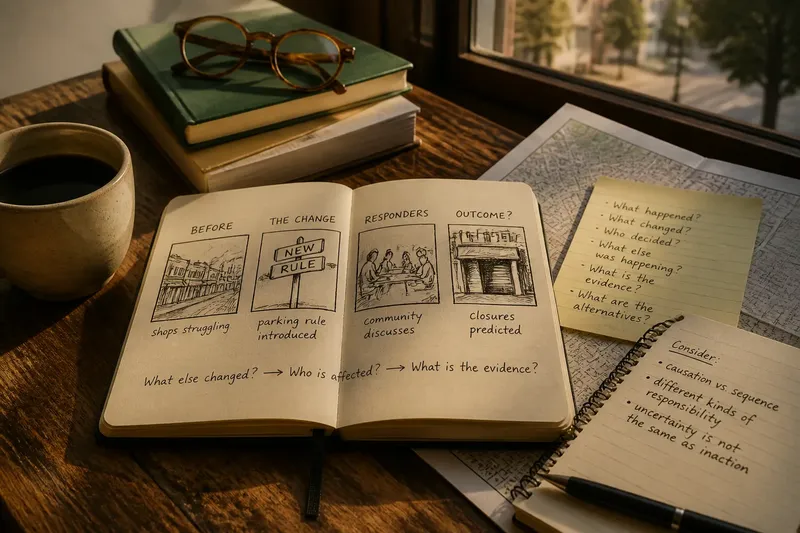
A person describes an outcome and a nearby event, then the sequence is taken to show that the event caused the outcome. For instance, a resident reports that a service worsened after a new policy began. That chronology may suggest a hypothesis, but it does not rule out other changes that happened at the same time.
The cause is the story’s natural beginning-middle-end shape. Events placed in sequence invite a causal reading, even when the account contains no comparison with what would have happened otherwise. The speaker may be describing the experience sincerely; sincerity does not settle the causal question.
Try separating the observation from the explanation. Ask what changed, when it changed, and whether other plausible causes were present. To assess a general causal claim, look for comparisons across relevant cases or periods, and for a method that considers competing explanations. An anecdote can suggest what to investigate; it cannot do that work on its own.
When disagreement becomes dismissal
Once someone challenges a story’s reach, the exchange can turn into a false choice: either accept the person’s conclusion or accuse the person of lying. Neither response is necessary. A report can be credible as an account of one event and insufficient as evidence for a broad pattern.
The cause is that people hear a challenge to the inference as a challenge to the experience itself. That can make careful distinctions sound cold, especially when the event involved harm or indignity. But refusing to distinguish the two can also leave the underlying issue poorly understood.
Try acknowledging what the account establishes before asking what remains open. “That sounds like a serious failure; how many similar cases have been recorded?” keeps the event in view while making the scope question explicit. The wording matters less than the distinction: respect the testimony, then assess the claim it is being used to support.
Illustration or demonstration?
Use a simple test: what job is the anecdote being asked to do? If it makes an abstract possibility concrete, gives context, or points to a neglected question, it is functioning as an illustration. If it is offered to establish frequency, representativeness, or causation, it is being asked to demonstrate more than one case can show.
An everyday analogy helps: one cracked tile tells you that a tile is cracked, not how many tiles in the floor are damaged. It is a reason to look more closely, not a count of the floor. Civic claims deserve the same modest distinction.
- Illustration: “A resident describes being turned away at the office.” This shows what one reported encounter involved.
- Pattern claim: “Residents are routinely turned away.” This needs evidence covering more than the reported encounter.
- Causal claim: “A new rule caused the turnaways.” This needs evidence that addresses timing and other plausible explanations.
Questions that clarify scope?
Can one anecdote ever count as evidence?
Yes, for a claim about what a particular person says they experienced, subject to ordinary questions about accuracy and context. It can also provide evidence that an event is possible, while leaving its frequency and representativeness unresolved.
What if several people tell similar stories?
Similar accounts can strengthen the case that an issue deserves attention, especially if they come from distinct people and settings. To infer how common it is, you still need to know how the accounts were selected and how they compare with the broader group.
How should a speaker introduce an anecdote?
State what the account is meant to show and what it cannot establish by itself. “This is one reported case; it raises a question about whether the problem is wider” is more accurate than presenting the story as a verdict.
What evidence fits a claim about a pattern?
The method depends on the claim: routine records may suit service frequency, a well-designed survey may address reported experience, and comparisons across cases or periods may help assess causes. Check whether the evidence covers the relevant people, time, and outcome rather than assuming any large collection of stories will do.
Match the evidence to the claim
When a story carries a broad conclusion, do not begin by deciding whether it is moving enough to believe. Identify the conclusion, then ask what kind of evidence could support it. That small pause prevents a vivid case from quietly changing its job halfway through the conversation.
The anecdote that stands in for a pattern may be the first useful clue in a public discussion. Keep it as a clue: preserve the concrete account, state its limits, and seek evidence suited to the wider claim. A good argument does not make one person’s experience bear the weight of a whole population.